
How do you talk to someone you love? How do you talk to yourself?*
"Try talking to yourself as you would to someone you love," my supervision coach said to me as I was spiraling out. I was working through a misstep I had made. It was painful, but not the end of the world. I am learning (sometimes the hard way) and will do better next time.
The spiral came in waves. The first wave was the shame and embarrassment I had over making the mistake in the first place. Next the shame over spiraling out arrived, followed by the shame about having this huge reaction in front of someone I like and admire so much. I was drowning in a flooded amygdala response that cut off all rational thought so I couldn't speak, couldn't answer questions, couldn't make any sense of anything.
I recognize that part of this reaction is due to RSD that comes with ADHD (hello late diagnosis!) RSD — Rejection Sensitivity Dysphoria — causes an intense, sudden wave of emotional or physical pain triggered by real or perceived rejection, criticism, or failure. (Thanks Google.) It goes along with people-pleasing and perfectionism, which also goes along with overworking — the trifecta!
But RSD or not, I am realizing the standard of perfectionism I have for myself, and the propensity to grind, work really hard, and allow no rest or weakness, is not just unkind to myself but also it just doesn't work anymore. As we say, it's no longer serving me. And it's something I coach my clients through all the time. So what gives? It turns out I don’t talk to myself the way I would talk to someone I love. Not even someone I love someone I know! Or have ordered a coffee from once.
We talk a lot in coaching about the "shitty committee." (Some people may use other words, not I, since my friend gave me this term.) This is the tape that runs in the background in your head that makes sure you don't forget that you actually suck, are unworthy, and that it will never work. It continually shocks me to understand that most, if not all, people have this tape running, and it can be our life's work to tell it to shut the hell up. This voice might originate with our parents or caretakers, or religion, or societal conditioning, or who knows what else and probably all of the above. But at some point, we adopt it as our own and give it a lot of power. Like ALL the power. As if it's true.
We know it's not true. And yet it still wins sometimes. Especially when we're doing something new, or difficult, or vulnerable.
Elizabeth Gilbert talks about something similar in her book, “Big Magic”. She calls it Fear, and it always shows up when she's embarking on a creative endeavor. But she has learned to put it in its place.
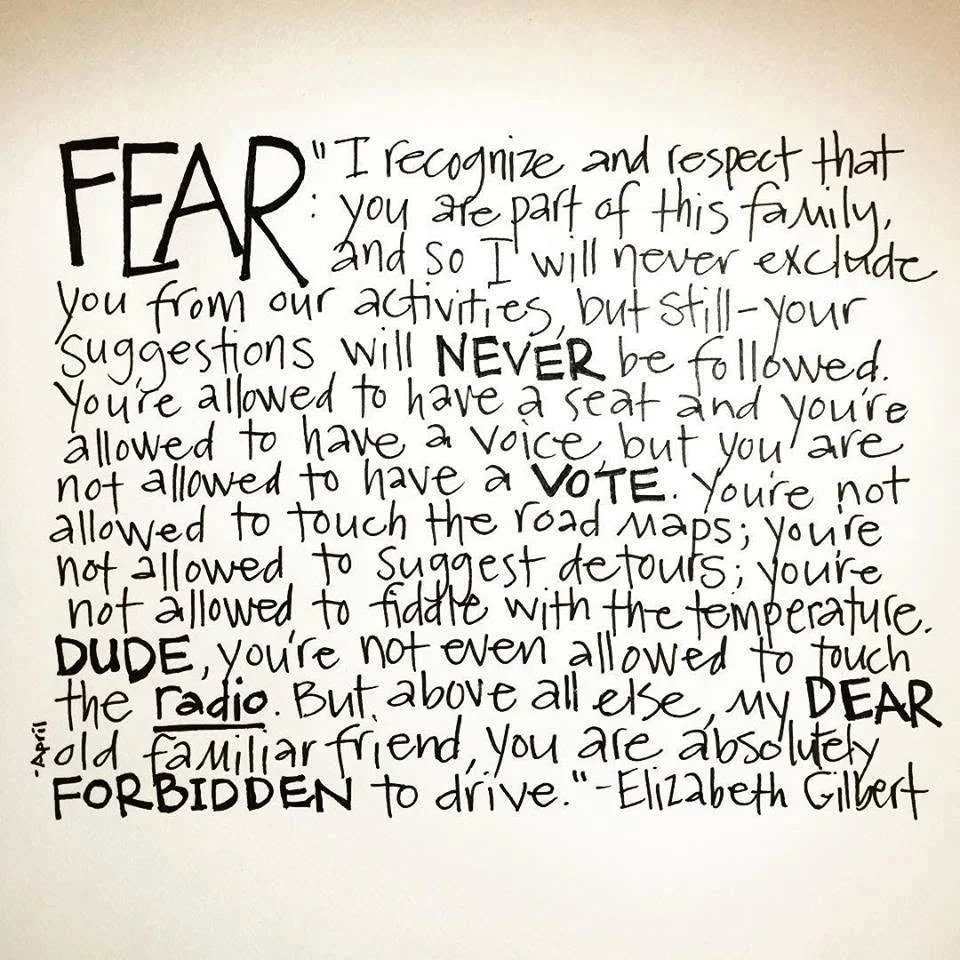
This rendition was made by @April Hadley
Liz has learned to speak to fear in a way that she would talk to someone she loves.
Another juicy quote from that same book: "Whatever you do, try not to dwell too long on your failures. You don't need to conduct autopsies on your disasters."
I read that book when it came out in 2015, and I still quote it all the time. It might be time to read it again.
So all this to say, I am still working on my stuff. Hopefully we all are.
. . .
Meanwhile on the podcast...
I took a little summer hiatus and then came back strong with some wonderful guests who brought incredible conversations. Aiko Bethea,Jennifer Tankersley, and Susan Lanphier all came at this idea of being loving to yourself from different angles.
Susan talked about the power of the pause. That is, taking a second to hesitate before you react or respond, so you can choose. This is way easier said than done, but comes with practice and reps and learning how to breathe and be more present. Implementing a pause when you feel triggered can give you a fighting chance to show up how you want to when things get spicy. Here's the TLDR: any time you have the urge to spin around and start a sentence with "and you know what?" you're probably in trouble and need to stop and take a breath before you finish that thought. I'm thinking of it as shame spiral prevention practice.
Jennifer laid out a new formula for measuring success when you move from someone who gets to check off all the boxes of tasks every day, to someone who is asked to do a higher level of work that ironically has many fewer boxes to check. The lack of checkmarks can be disorienting until you begin to measure different and less tangible but even more important things. What is actually being asked of you now? Jennifer walked us through her value equation and made the case that rest isn't the reward for the work, it's part of the job. You must care for your nervous system so that you can act from a place of calm and presence.
Aiko and I had a conversation focused around some concepts in her new book, Anchored, Aligned, Accountable — A Framework for Transcending Bullsh*t and Transforming Our Lives and Work. We talked about values (what really matters to YOU, despite what anyone else says), bullshit (what is the nonsense we have bought into that is running our lives), and most of all, Says Who? (who's scripts are we conforming to?) And the most delicious definition that we have been living in and needing to name: the Bullshit Asymmetry Principle — the energy needed to refute false information is much greater than the energy required to create it. I mean...
Three different vocabularies, one instruction underneath all of them: quiet the noise, give yourself space, take care of yourself in a loving way.
. . .
What's coming up...
As usual, I'm getting some beautiful opportunities to practice what I'm learning. This fall we're selling the Nashville house and moving to Seattle. And though there are many many checklists for what needs to be done, and there is no tidy checklist for the kind of uncertainty we are being asked to live in at the moment, and care for our nervous systems is front and center. Expect even more musings about transitions in the near future. Probably pottery related. I have the sweetest pottery community here that I will miss very much.
And, the podcast will continue but on a less regular schedule. In the interest of working on not overworking (is that additive?) I am going to do the podcast on a schedule that works with my life rather than weekly. I still expect it to be frequent, but I am removing the pressure of a new episode every Tuesday morning. If anyone is waking up excited on Tuesday mornings looking for the brand new Deep Work Out Loud, do let me know. I would be surprised, because there are some podcasts I'm obsessed with and still don't do that.
. . .
On the home front...
My son (20) spent the summer with us in Nashville for an internship. What a treat it was to get to know him as an adult, and what a joy to watch him and my husband become pals. For anyone whose nest is emptying, they're not gone forever, and some seasons, they migrate back.
. . .
In the coaching corner...
I remain inspired by my clients who are leaning in and doing really transformational work. This work isn't easy, but it's worth it. I mean, you're here. And there aren't any rules anymore. Why not work on being the fullest expression of who you were put on earth to be?
If any of this is landing, that's the work I do. Let's talk about what it would look like for you.
*as always em dashes are my own
Julie Harris Oliver is an executive coach working with high performers making the transition to executive leadership and creatives wanting to do the thing. She is the host of the podcast Deep Work Out Loud and is vowing to speak to herself with a bit more kindness and grace. You can find her atjulieharrisoliver.com.

the summer hiatus